
Ned Raggett on Independent Project Records
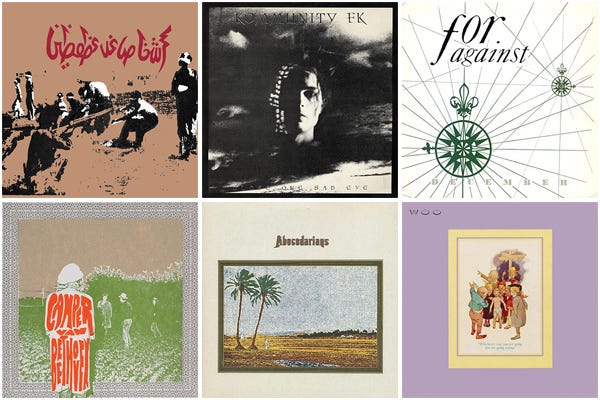
There have been any number of labels that have made a virtue of a unified visual design for their releases, but there are few with an aesthetic that encompasses the sense of touch. That requirement was foundational to the origin of long-running Independent Project Records, or IPR for short, founded by artist, musician and designer Bruce Licher in Los Angeles in 1980.
Collections
Nate Patrin on Jazz is Dead
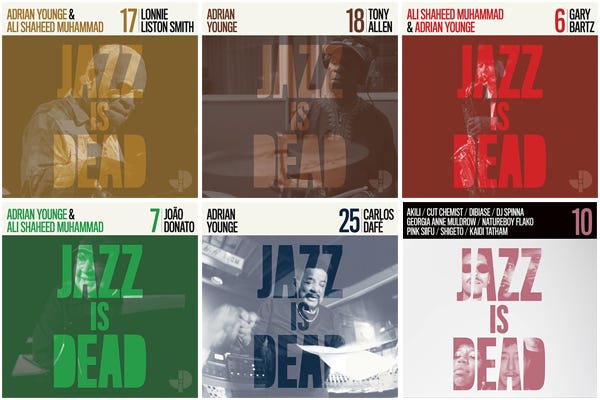
The cratedigger-as-curator has been a vital presence in both jazz and hip-hop for multiple generations now. And reps from two of those generations — ‘90s-rooted golden era DJ/producer Ali Shaheed Muhammad, and slightly-younger 2010s-breakout arranger/beatmaker Adrian Younge — pooled their exhaustive ‘70s-baby knowledge and resources to establish one of the last decade’s most successful preservationist/revivalist projects. Naturally, they called it Jazz Is Dead — a pre-emptive sarcastic riposte to the old sentiment that was proving to be increasingly misguided throughout a decade marked by a niche-yet-rich resurgence in the form. With Kamasi Washington, Thundercat, and Jeff Parker at the forefront of a revival, it only made sense for their contemporaries to reach out to their predecessors.
Harold Heath on Bob Shad’s Mainstream 300 Series
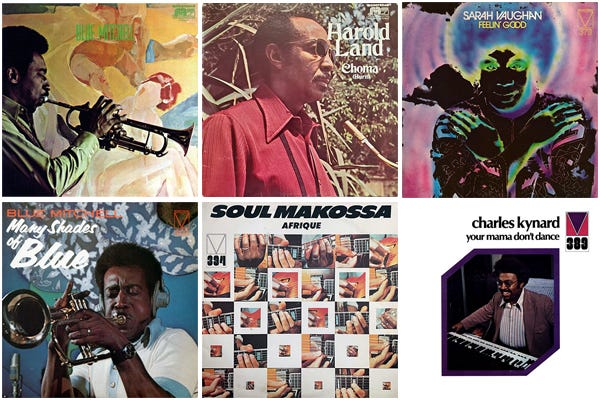
Record producer and label boss extraordinaire Bob Shad launched his Mainstream label in the mid sixties, beginning with jazz reissues before branching out into soul, R’n’B, pop, easy listening, hippie rock, and his beloved jazz. The Mainstream MRL 300 series ran from 1971 to ’74, releasing over 100 albums, most of them jazz of some description, along with a handful of outstanding soul vocal albums too. Fifty years on and the 300 series catalogue remains an outstanding source of surprisingly unknown and underplayed jazz.
Reviews
Shy Clara Thompson

Sugar Plant / One Dream, One Star
Sugar Plant worked hard for their stature as Japan’s indie rock darlings. Early in their career they squatted in other band’s houses, practicing in dingy basements, scrounging for the funds to rent out recording studios. The sound they were developing, shaped by American indie, felt out of place in their country’s underground scene, which was riding a wave of influence from the UK instead. Feeling ignored in Japan, they took a gamble on releasing their music abroad — and it paid off.
Tommy Sims / Peace and Love
Some artists leave an undeniable mark on history without ever making their names widely known. This is the case for Tommy Sims, whose list of accomplishments should have made him one of the most famous musicians on the planet.
Inrain / Rise
It’s pretty surprising, then, that the most obscure A.R. Kane apocrypha of all would see a reissue 35 years after the fact. Rise is an expanded remaster of Tambala’s collaboration with Alison Shaw of Cranes, originally released as 7” you could only receive by mail order as part of Rough Trade’s Singles Club.
Harold Heath

The Olympians / In Search of a Revival
The second album of retro instrumental cinematic soul and funk from Toby Pezner’s crack team of NY session players, In Search of… features twelve tracks of brass laden Spaghetti western grooves, faux blaxploitation themes and Kung Fu movie soundtracks for films that don’t exist.
Xylitol / Blumenfantasie
DJ and producer Catherine Backhouse second album under her Xylitol alias is an immersive collection of kosmische jungle, ghost breaks, and haunted drum & bass. Although derived from club music, to me this is very much a headphones album, the kind of album that builds its own distinctive, uncompromising sonic world.
Another Taste / Another Taste II
Rotterdam-based band Another Taste make contemporary post-disco / boogie / electro-soul: think a 21st century take on the dancefloor jams of the Prelude / West End / Salsoul labels.
Jon Dale

Diamanda Galás / De-Formation: Second Piano Variations
De-formation: Second Piano Variations is a rare treat, a Galás solo performance from Paris, France, where she reworks the piece’s first ‘variation’, a 2020 recording that abstracted out from a prior work, a setting of German writer Georg Heym’s Das Fieberspital.
Fallen Flowers / Fallen Flowers
Fallen Flowers is Scott’s new project, and it’s surprising both in its lifting of the hazy veil that’s occluded much of his previous music, and in its pointillist character, mostly consisting of guitar ping-ponging arpeggios with a verdant lushness that recalls Vini Reilly of The Durutti Column, or Maurice Deebank of Felt.
Aldous Harding / Train on the Island
Train on the Island’s wry folk-pop-etc. doesn’t yield its pleasures as readily as, say, 2019’s Designer, but it does a good job of highlighting several things about Harding’s writing: symmetry and exactitude (the structural echoes of “One Step” and “San Francisco”); modular builds (“What Am I Gonna Do?”); ambivalence and uncertainty.
Sean Wood

Jerry Goldsmith / Chinatown
The story goes that Jerry Goldsmith wrote and recorded this score in ten days, after the film’s producer Robert Evans pulled Phillip Lambro’s finished score at the eleventh hour. Economy of means turns out to be the score’s biggest strength. It works in dabs and brushstrokes, relying on a tight, clever, and unusual set of sonic textures.
Jonny Greenwood / One Battle After Another
The majority of the score for One Battle is filled with clicks, taps, and echoes pulsing away in the background, seeming to put the film on a treadmill; reminiscent of the rhythmically-twitchy pair of records Greenwood has recently made with The Smile.
Dr. John / The Brightest Smile in Town
In the early ‘80s, Dr. John made a series of unassuming solo piano recordings like this one, quiet documents of one of the great piano stylists of his time. On the surface, the playing is effortless, but closer up, it starts to look strange and idiosyncratic — like his mentor James Booker, he stuffs the normal frameworks of New Orleans with just about as much rhythm as it can handle, loading it with quick and brittle runs, skitters and flourishes (“Didn’t He Ramble / Closer Walk With Thee”).
Andy Beta

Olof Dreijer / Loud Bloom
Dreijer finally re-emerges with Loud Bloom, a solo debut anticipated for decades, revealing the neon-bright throughline connecting all those disparate, far-flung sonic elements of his music.
Marc Leclair / Musique pour 3 Femmes Enceintes
Canadian producer Marc Leclair garnered acclaim as Akufen at the turn of the century with his minimal banger, My Way, while the more dubby follow-up he rendered under his name, 2005’s Musique Pour 3 Femmes Enceintes, wound up under the radar. A recent vinyl reissue of that set some 21 years on reveals the slippery details of Leclair’s meticulous productions.
Ana Roxanne / Poem 1
Back in 2019, Ana Roxanne released two albums of hushed, ASMR-tinged ambient in quick succession. But it was a patient downtempo cover of Chris Isaak’s “Wicked Game” (by her duo with producer DJ Python as Natural Wonder Beauty Concept in 2023) that foregrounded their voice and hinted at where Roxanne might be headed next. And some six years after their last solo album, Poem 1 finds the Californian artist moving away from ambient towards something more like dream pop, that crystalline voice front and center.
Joshua Levine

Vanity 6 / Vanity 6
The trio’s sole album (from 1982) is long out of print and unavailable to stream officially. Which is a shame, because these Prince-penned, performed (with vocals from the group) and produced songs are uniformly excellent.
Sigur Rós / Takk...
Critics have always described Sigur Rós in terms that mirrored the physical characteristics of the band’s native Iceland – majestic, grand, glacial. But on Takk…, the post-rock group focused its signature elements into its most accessible work.
Hole / Celebrity Skin
Courtney Love was one of the visionary figures in the popular music of the 1990s. By the time her third and final album of the decade with her band, Hole, was released, she was one of the world’s most famous musicians, and Celebrity Skin reflects that on several fronts. The lyrics to the title track evoke Shakespeare (“I’m glad I came here with your pound of flesh”), the poet Anne Sexton (“My name is ‘never-was’”) and the titular exploitative porn magazine to illustrate the disposability of women in the entertainment industry aspiring to fame.