
Jon Dale on Spectral Music
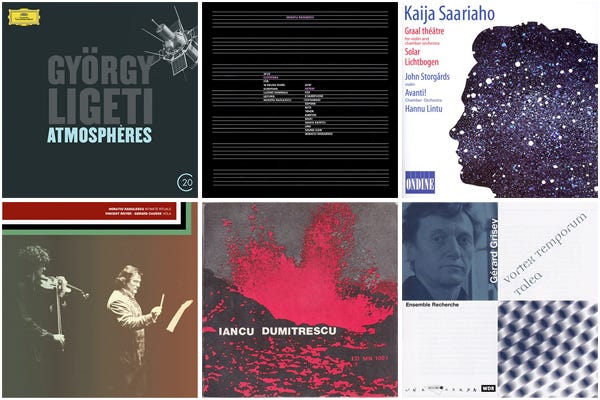
Certainly, then, sound and timbre are the fundaments of spectral music. The ‘movement’ arose as one of several responses to the overbearing and homogenising force of serial music in ‘avant-garde’ classical across the first half of the twentieth century, where compositions were placed in subservience to the structural constraint of serialism. Spectral music wished to undo such dogmatism and instead explore the inner structures and manifold possibilities of sound itself. There are loose ideological parallels with other responses to serialism – say, the minimalists in America, particularly La Monte Young – but spectral music comes at this from a very different angle.
Collections
Andy Beta on Blue Note’s Vocal Jazz
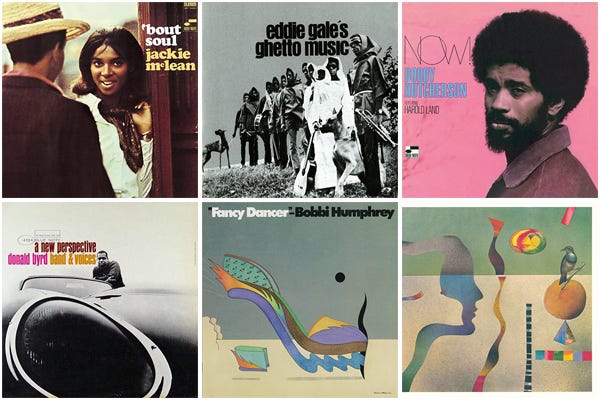
It also yielded a curious new hybrid. While Blue Note had all but eschewed vocal jazz and the like in its lengthy discography, it also became the home for a curious string of albums that amalgamated vocals with jazz into startling new forms. Some albums hearken back to the church music of the bandleaders’ childhood, while others feel dosed by the particularly mind-expanding acid trips of the late ‘60s. Lyrics might be soulful, spaced-out, or politically-acute.
Reviews
Nate Patrin

Martyn / Music for Existing
It’s as if all his stylistic traits that coalesced on Voids — the cavernous dynamics of reverbed snares and hi-hats, the glowing, unexpectedly warm core of dark synth chords, the anxious negative space you can feel when the sub-bass recedes — can now be channeled through entirely different tools. Music for Existing reconnects with the analogue, in part as a defiant stab against the idea that AI could create something out of nothing, and also as a way of using potentially-divisive, “inorganic” tech to reemphasize that it can still be in the service of an entirely human process. In this case, the music is built with the aid of good-old-fashioned sampling, and the fact that the samples are all based around instrumentation supplied by collaborators puts the lie to the idea that electronic music can’t be a truly organic collective effort.
Shabaka Hutchings / Of the Earth
Shabaka Hutchings was one of the most well-traveled players of a London jazz scene that often hesitated to call itself “jazz” — it was both too broad in its global and stylistic scope and too new in its own beatmaking hybridization to feel directly connected to old traditions. But even as he traded in his tenor sax for a succession of flutes and a desire to blur the line between improvised music and restructured beats, he also found a visionary pathway through it, synthesizing parallel identities as a producer and musician (in that order) to find the most elastic and modular work process he could. Of the Earth is his first fully autonomous album — all the instrumentation and engineering is his, as is the label he released it on — and for an entirely self-mediated album, it feels a lot more expansive than the work and the perspective of a solitary musician.
Boards of Canada / Inferno
The joys of hauntology aren’t what they were when Boards of Canada released Tomorrow’s Harvest back in 2013, much less what they were during their initial emergence some three decades ago. It’s become weaponized, a half-remembered dream manipulated to resemble a legitimate past that was cruelly snatched away from us and replaced by a howling void of a future. When people who believe this is the true existential crisis of their lives need somewhere to turn to figure it all out, they often wind up falling into a space where they’re susceptible to cultish separatism and apocalyptic ideation — and it’s this space where Inferno casts its brain-itching spell, an alpha-and-omega state of time-looping death and rebirth.
Amelia Riggs

Jim O’Rourke / Eureka
The juxtaposition between the profane and profound is exactly what Jim O’Rourke’s bread and butter has been since day one. His first proper singer-songwriter album for Drag City, Eureka is a propulsive river of strings, horns, bells, steel drums, and that idiosyncratic guitar playing that grabs you by the ears and pulls.
Jim O’Rourke / Insignificance
Recorded with members of Wilco, this is anxiety rock for the nervous and angry; oftentimes the lyrics get downright bitter and cruel (see “Memory Lane” with its litany of incredible insults such as “looking at you reminds me of looking at the sun/and how the blind are so damn lucky”) thrillingly tragic (“Get A Room” narrates a man given one day to live bringing someone home, only to slowly feel his body disintegrate while looking at the sleeping stranger in his bed) and all set to the lushest arrangements, most blistering rock, and most teeth chattering noise to hit you in 7 songs or less or no money back.
MJ Lenderman / Manning Fireworks
On reflection it’s always wild when albums about loneliness, isolation, and self flagellation end up becoming monumental hits. That old idea of the specific being universal clangs through the entirety of Manning Fireworks, an album about weighing the pros and cons of solitude in the shadow of heartbreak.
Phil Freeman

Lazy Cowgirls / Somewhere Down the Line
At the beginning of the ’80s, four friends from Vincennes, Indiana — vocalist Pat Todd, guitarist Doug “D.D. Weekday” Phillips, bassist Keith Telligman, and drummer Allen Clark — moved to Los Angeles and started the Lazy Cowgirls, one of the best and least-lauded American punk bands of the 20th century.
The Cramps / Songs the Lord Taught Us
Songs The Lord Taught Us, produced by Alex Chilton, took the pounding beat and simple riffs of early rock ’n’ roll, played with perfect rawness by guitarists Poison Ivy Rorschach (the band’s unacknowledged mastermind) and Bryan Gregory and drummer Nick Knox, and let frontman Lux Interior go wild up front.
The Blasters
The Blasters’ debut album, released on the tiny Southern California indie Rollin’ Rock, was called American Music, about as clear a declaration as one could ask for. This follow-up, released on Slash and picked up by Warner Bros., has a richer and fuller sound (they started out as a quartet, before adding piano and two saxophonists), but the band absolutely lives up to their name, blasting the listener with a mix of rockabilly, jump blues, and hybrid forms — “Marie Marie,” this album’s thrilling opener, crosses Chuck Berry with the Balfa Brothers, an acoustic Cajun band. There are a few covers here, like Sunnyland Slim’s “Highway 61,” Rudy Toombs’ “I’m Shakin’,” Bo Diddley’s “I Love You So,” and Jimmie Rodgers’ “Never No More Blues,” but the emphasis (seven out of 12 tracks) is on guitarist Dave Alvin’s songs, which blend romanticism with blue-collar detail in a manner worthy of Merle Haggard.
Jeff Treppel

Carpenter Brut / Leather Temple
French darksynth maestro Franco Hueck announces his return to cyberpunk with an appropriately bombastic fanfare. After several experiments with eighties-style pop and metal, Leather Temple ditches the vocals and the rock exoskeleton in favor of the sweeping synth bangers he excels at.
Genghis Tron / Signal Fire
The future of warfare is here and it’s sonic. Originally a grindcore trio that supplemented their blast beats with chiptunes, Genghis Tron went dormant for a decade and returned, reconfigured, in 2021 with new members and a new sound, spearheaded by original keyboardist Michael Sochynsky and guitarist Hamilton Jordan. Dream Weapon brought them into the digital realm by filtering Nine Inch Nails through a wall of shoegaze amplifier fuzz. This evolves that approach.
Slift / Fantasia
Slift’s trip through the outer reaches of all things psychedelic and heavy never takes predictable turns. After the French trio experimented with the possibilities of longer-form songwriting on 2024’s 80-minute masterpiece Ilion, Fantasia brings them back to (relatively) contained missives.
Joe Muggs

La Sécurité / Bingo!
There’s about as much distance between their formation and the early 00s breakthrough days of DFA records as there is between DFA and their original post-punk inspirations – but the style is just right for them, and still has power to make you snap to attention.
Shackleton / Death by Tickling
A Japanese artist who cut his teeth in the early days of the Southern English breakcore scene then renamed himself after a Ugandan street food while expanding outwards into all kinds of manifestations of global bass music, teaming up with a lugubrious Lancastrian with a squat punk background and taste for apocalyptic imagery and absurdist expression who had a stint on the outsider fringes of dubstep and techno in London before carving out a unique dub space for himself in Berlin? Why yes, that IS how we like our modern psychedelia to be birthed.
Tim Reaper / In Vain
With 20 tracks apiece, sfs and In Vain touch on 80s digital reggae, dubstep, R&B, house, hippie rave experimentalism and much more besides, blurring boundaries and short circuiting temporality so all questions of futurist/retro are thrown out of the window, and it becomes entirely about personal expression of intense emotion and self-reflection.