
Happy New Year everyone! Usually we do an EOY list round about now but time got away from us. Maybe next month? Or even March. Or maybe we’ll skip it altogether. You’ll know shortly after we do!
Nate Patrin on The World of Kenny Dennis
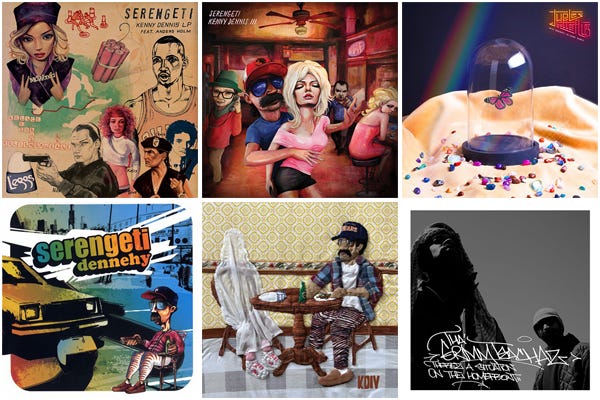
Concocted by Chicago rapper Serengeti (nee David Cohn) and given his first major place of honor as the featured character on the cover and title cut of his 2006 album Dennehy, Kenny is a fascinating study in how a detail-focused rapper with a deep interest in the inner lives of the people he writes about can develop a fictional presence into someone that feels deeply resonant, even real.
Collections
Hank Shteamer on Jim White
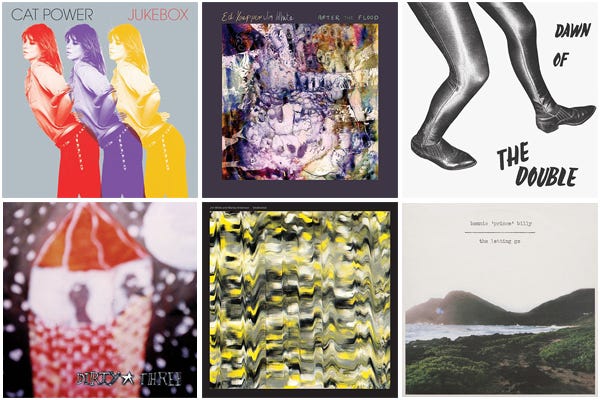
Neither a chameleonic sideman nor a freewheeling improviser, neither a rock specialist nor a jazz swinger, Jim White is sui generis — as much his own species as, say, Milford Graves or Keith Moon. As subtle as his contributions to the work of Bill Callahan, Cat Power or Bonnie “Prince” Billy can be, he’s never a mere background presence. And in his collaborative duos with Nina Nastasia, Marisa Anderson, Ed Kuepper, Cretan laouto player George Xylouris (in Xylouris White) and Emmett Kelly (in the Double), or his signature and longest-running project, Dirty Three, he’s as much a lead voice as anyone else — his percussion always contributing deep atmosphere and almost shamanic sense of mystery.
Chris Catchpole on Vaporwave
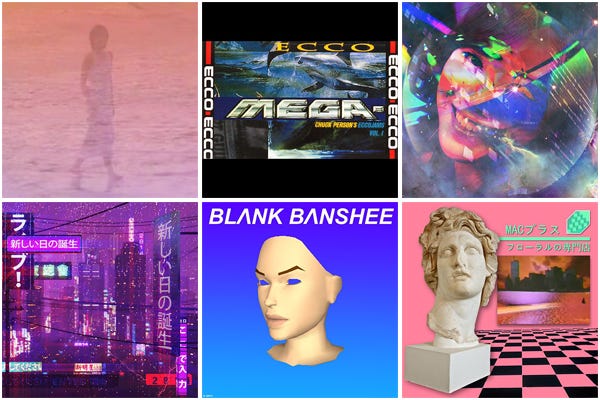
Whether this chopped up, dreamlike melange of glitching beats and warped ‘90s R&B and ‘80s soft rock samples was ironic self-parody or genuinely subversive (debates continue whether it was a critique or celebration of hyper-capitalist society), its signifiers and sounds began to bleed into the mainstream, with Rihanna, Azealia Banks, The Weeknd and Yung Lean among those smearing Vaporwave’s digital gloop on their own records.
Harold Heath on Matthew Herbert
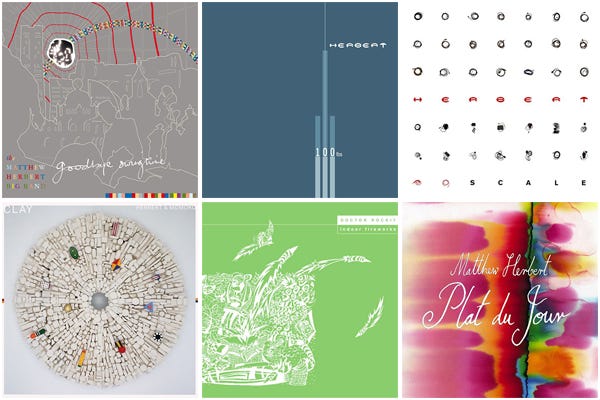
Herbert never uses sampling to recreate or reminisce; instead, he always uses it as a source to create something new, and his music quickly moved beyond his mid-90s deep house debut, blossoming in multiple directions. Recording under numerous names, including Herbert, Doctor Rockit, Radio Boy, Wishmountain, and DJ Empty, he released jazz, electronica, disco, classical, big band swing jazz, torch songs, and all sorts of experimental and avant-garde hybrid experiments and combinations.
Reviews
Jon Dale

Ashra / The Making Of
Collating some of the sessions that led to 1979’s Correlations, The Making Of is, by its nature, a much rougher beast, and more charming for that. Part of the joy is in hearing the Göttsching-Grosskopf-Ulbrich line-up letting their hair down in the studio; there’s a case to be made here for extended jams being the trio’s best side.
Seefeel / Pure, Impure
Seefeel were never shoegazers – let’s make that clear. There are some loose relationships, primarily to do with textural information and ‘new’ approaches to the guitar, but unlike the shoegaze crowd, who gestured towards pop sensibilities, the song was never Seefeel’s forte. Rather, they created a series of occluded spaces that initially appear static and empty, but reveal both intricacy and intimacy as you dive deeper.
Kingdom Come / Journey
In a blindfold test, you would swear that Journey, the third album by Arthur Brown’s Kingdom Come, was a lost early eighties post-punk masterpiece, such is its predictive qualities.
Sean Wood

Lee Morgan / The Gigolo
Morgan’s synergy with Wayne Shorter is a highlight of this 1965 session; on “Trapped,” the two one-up each other with big entrances, leading up to a blistering trading-fours section. Excellent Morgan originals form the album’s backbone: the brash “Yes I Can, No You Can’t,” the quirky blues “Speedball,” and the turbulent title track. A set that overflows with melody and swagger.
Alarm Will Sound / Land of Winter
The piece features a satisfyingly diverse range of textures that point back to his influences: spectralism (the glacial colors of “December,”), Andriessen (the teeming rhythms of “July”). But it avoids typical new-music moves for depicting the natural world, helped along by its idiosyncratic subject: Ireland’s weather manages to be both gentle and hostile at once.
Ars Nova Copenhagen / First Drop
There is such clever sequencing here: African rhythms into medieval rhythms (Kevin Volans’s “Walking Song” into Ortiz’s 5 Motets), color into rhythm (Skempton’s “More Sweet Than My Refrain” through to Reich’s “Clapping Music”). Traversing distinctions between musical worlds are what Hillier and Ars Nova Copenhagen do; both are known for their work in both early and contemporary music.
Andy Beta

Catalyst / Perception
Comparison to Herbie Hancock’s Mwandishi group of the era isn’t just critical shorthand, in that Catalyst both utilized the services of Mwandishi percussionist Jabali Billy Hart and synth wizard Pat Gleason and adopted Swahili names. “Celestial Bodies” suggests the zero gravity drift of its title, before finally settling into a cosmic groove full of Nwalinu Odean Pope’s tenor sax cries. Like a visiting flying saucer, some nine minutes in, the piece then soars back up into deep space.
Jessica Williams / Blue Abstraction: Prepared Piano Project 1985–1987
But nothing is quite like the personal recordings she laid to tape in the mid-’80s, wherein she utilized the prepared piano strategies of John Cage and Henry Cowell to drastically alter the sounds of her 88 keys. Blue Abstraction finally brings this unheard element of Williams’s music to light.
Attica Blues Orchestra / Things Have Got to Change
Each of Archie Shepp’s Impulse records from the 1960s and ‘70s seemed to reveal a wholly new side of the man and his musical concerns. So consider Things Have Got to Change, his 11th album for the imprint, to be yet another side of his hendecagon.
Amelia Riggs

Sunn O))) / Eternity’s Pillars b/w Raise the Chalice & Reverential
Oh thank Satan, the Cloaked Ones are back when we needed them most. Despite the foundational templates and tropes that make up a Sunn O))) recording (low end distorted drones, played loud and long), you truly have not heard them all when you’ve heard just one.
Neko Case / Neon Grey Midnight Green
Neko Case albums are growers, and I do not mean this negatively. Quite the opposite. She makes music for repeated, intense listening, figuring out the turns of phrase and always being surprised when the heart’s blood seeps out of the steel wool her pen concocts.
Frightened Rabbit / The Winter of Mixed Drinks
An ex of mine complained about my own music while we were dating, saying “you can’t make every song sound like the last song on the record.” To which Frightened Rabbit respond time and again “hold my many many many beers.”