
Rick Anderson on Power Pop
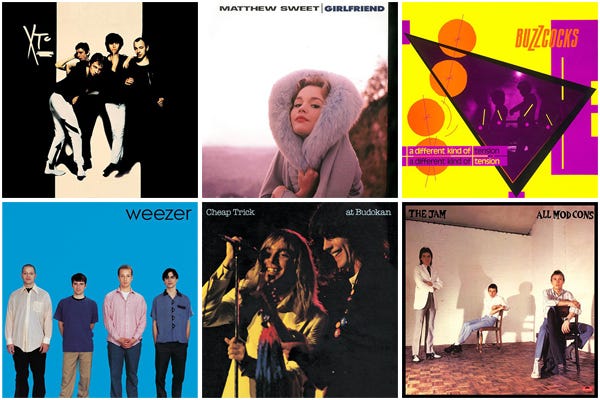
On the macro level, power pop’s rise came at roughly the same time as the punk explosion; this tended both to obscure its emergence (since everyone was distracted by the seismic impact of punk’s arrival) and to create a certain amount of genre confusion: were the Nerves punk or power pop? Elvis Costello’s songs show up regularly on power pop compilations – but he got lumped in with punk as well. How about the Buzzcocks, or the Jam, or XTC? Or even the Police’s first album?
Collections
Amelia Riggs on 2000s Blogrock
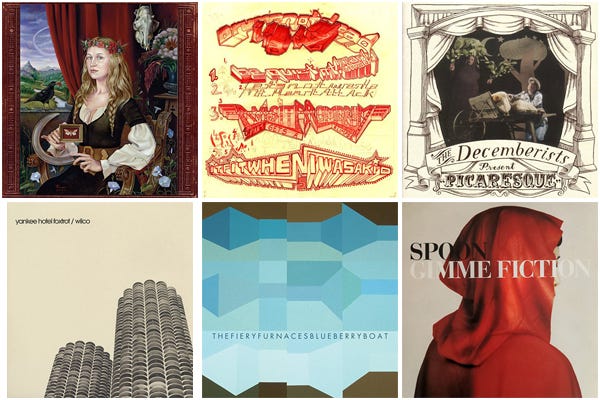
I was there. And so were you, most likely, if you’re reading something called “2000s Blogrock” on a website dedicated to recommending and archiving music. Post 9/11, all music shifted with the culture, and indie music especially started to have another renaissance thanks to the rise of blogs and websites like Pitchfork, Stereogum, Consequence of Sound, and countless others.
Phil Freeman on Shred Metal
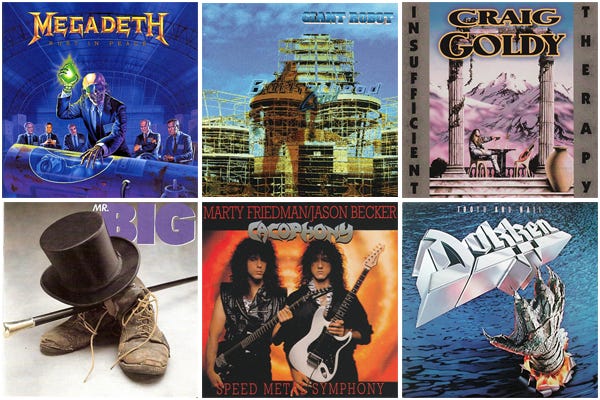
Eddie Van Halen is often seen as one of the most important electric guitar voices of the latter half of the 20th century. His high-speed finger-tapping and dive-bombs, leaping out of the band’s crunching, plodding riff-storms like a salmon flipping out of a river, sounded like no one else, and inspired an entire generation of players who in turn transformed metal in the early 1980s. Some of those guitarists were members of regular-degular metal bands, writing catchy songs aimed at hard rock radio and limiting themselves to flashy but short solos. The hardest of the hardcore, though, asked themselves, “What if the whole album could be ‘Eruption’?”
Joe Muggs on Gilles Peterson
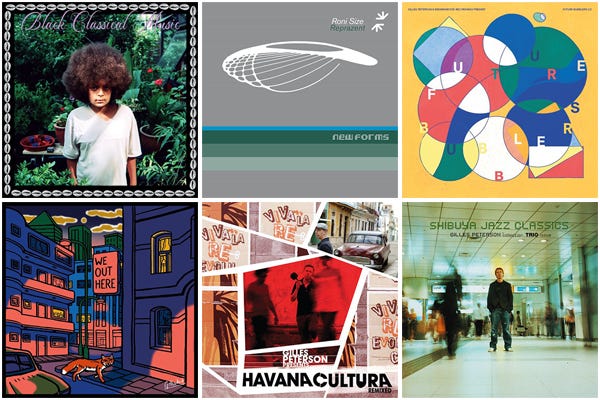
Just before the time of writing this, Gilles Peterson proudly announced his fifty-five thousandth record played on BBC Radio. Quite the achievement, but only the tip of the iceberg for a man with a Stakhanovite work ethic powered by the constant pursuit of delight. Peterson’s shows on various BBC channels over 40 years are in addition to the pirate radio where he cut his teeth, weekly appearances on his own globally syndicated Worldwide FM, relentless international touring as a club DJ including all kinds of residencies, and never-ending work as a curator of records, record labels, shows and festivals.
Reviews
Jon Dale

Eden Aurelius / Entre Nous
It makes sense that the woodland drifts of GAS’s Pop album were a formative influence for American electronic producer Eden Aurelius – the music on Entre Nous, her debut album, has a similar haziness, and a fondness for layering of blurred textures. Aurelius’s music sits in that sweet spot somewhere between ambient and dub techno – not exactly an underpopulated place, but Aurelius does it particularly well.
The Crying Nudes / DJ
It’s not too hard these days to sketch a career out of being shadowy and embracing mystery and slipperiness – few have done it quite as well as Dean Blunt, though, whose two decades of music-making so far have been marked with sideways swerves, unannounced drops and rumour mills. He’s most likely behind The Crying Nudes, though, that’s for sure, and that voice is Danish singer Fine, whose 2024 album Rocky Top Ballads was a sleeper gem.
Dejing / Dejing Dejing
Second album for this elusive project: the only clues to who’s behind Dejing is the label’s blurb about an “NYC underground lifer.” That could be quite a few people, by anyone’s reckoning. It’s released on Pat Murano’s Daksina label, which might place it in the No Neck Blues Band orbit, but that’s a pretty big field.
Harold Heath

Scrimshire / Bring Our Light to Every Corner
South London multi instrumentalist/DJ/label boss Adam Scrimshire’s tenth solo album is a six track collection of hybrid spiritual jazz/autumnal folk, a beguiling combination of the cosmic and the pastoral, laced with traces of the cinematic psychedelic soul jazz productions of Charles Stepney mixed with Scrimshire’s distinctive, introspective rural English aesthetic.
Nubiyan Twist / Chasing Shadows
This, their sixth album since their 2015 debut, continues their jazz/sound system aesthetic, with joyous hip hop/brass ensemble hybrids, churning, intricate Afrobeat jams, irresistible jazz dance head-nodders, while also branching out into more sweet, stepping soul-jazz too.
Donato Dozzy, Batu / Exhale
The eight tracks that make up UK producer Batu and Rome’s Donato Dozzy’s Exhale album create their own self contained sonic world, abstract, wordless, sophisticated, futuristic, and intense. You could call it a techno album but the tracks strain at the very edges of the genre’s boundaries, with Batu bringing a distinctly UK bass music feel to the productions, with detailed, intricate, unearthly percussion and drums, and heavy duty bass.
Sean Wood

Nat King Cole / Those Lazy Hazy Crazy Days of Summer
A trifle? Maybe. A rare successful visit to the sound of the 1890s? Definitely. You can find recordings of “After the Ball” or “Sweet Rosie O’Grady,” but they’re more often historical documents than recordings that can be enjoyed. These sparkling performances (see especially “On the Sidewalks New York”) give these old “popular waltzes” back the luster they must have once had.
Raffaele La Ragione, François Dumont, Sandrine Piau / Mandoline: Dans les salons fin-de-siècle
Late 19th-century Paris was swept by a wave of desire for the exotic — Javanese gamelan, for instance, bowled Debussy over at the 1889 Paris exhibition. Another object of desire was the sun-drenched Mediterranean, especially Italy and Spain, Bizet’s Carmen being a famous remnant. Mandolins were part of the vogue.
Giovanni Antonini, Sheng-Fang Chiu / Byrd and the Bird
The recorder here acts like a time machine, zipping between historical eras and affects. Arrangements of Bartók violin duets sit coherently alongside Baroque suites (Hotteterre, Telemann), unusual Renaissance pieces (“Upon La Mi Re”), and music composed in 2024 (see Giovanni’s Solliima title track).
Andy Beta

SML / Spontaneous Music Live
Genre tags have a way of lingering around bands, just ask the early UK bands that got saddled with the “shoegaze” tag. Credit former WFMU DJ Scott McDowell with the hashtag “gorp jazz” – whose characteristics include space, texture, atmosphere, and “depth over drama” – which was promptly affixed to LA unit SML, the five-piece becoming poster children for this new sound, equally indebted to Terry Riley and minimalism as it was to ECM and post-rock.
Topdown Dialectic / False LP A
A proper Topdown Dialectic full-length (now credited to producer/ sound artist Izaak Schlossman) keeps many of the same parameters of prior TD product intact, while letting in flashes of color that feel all the more iridescent.
Ryuichi Sakamoto / Beauty
But Beauty is also misconstrued as something of a major label failure in Sakamoto’s expansive catalog, a Rolodex-heavy album that didn’t quite reach the same electric peaks of his earlier solo efforts. But thanks to a stunning new vinyl reissue of this album, Beauty’s true uh…beauty shines through.
Joshua Levine

The Strokes / The New Abnormal
They finally slowed down and stretched out on The New Abnormal, and the result was some of their most effortlessly beautiful and affecting music since their early days.
The Strokes / Reality Awaits
Two decades after their debut, The Strokes were more popular than they ever were, fueled by an enormous Gen Z audience who viewed 2020’s excellent The New Abnormal as the artistic equal to the group’s classic early work. That album is used as a jumping-off point for Reality Awaits, the most experimental and murky record The Strokes have ever made. In other words, this is The Strokes’ art-rock album.
Apollonia 6 / Apollonia 6
The sole album by pop/R&B trio Apollonia 6 began as the follow-up to Vanity 6’s 1982 debut. However, frontwoman Vanity left and was replaced with singer Apollonia. Like Vanity 6, this album is a minor gem, produced, written and instrumentally performed by Prince.